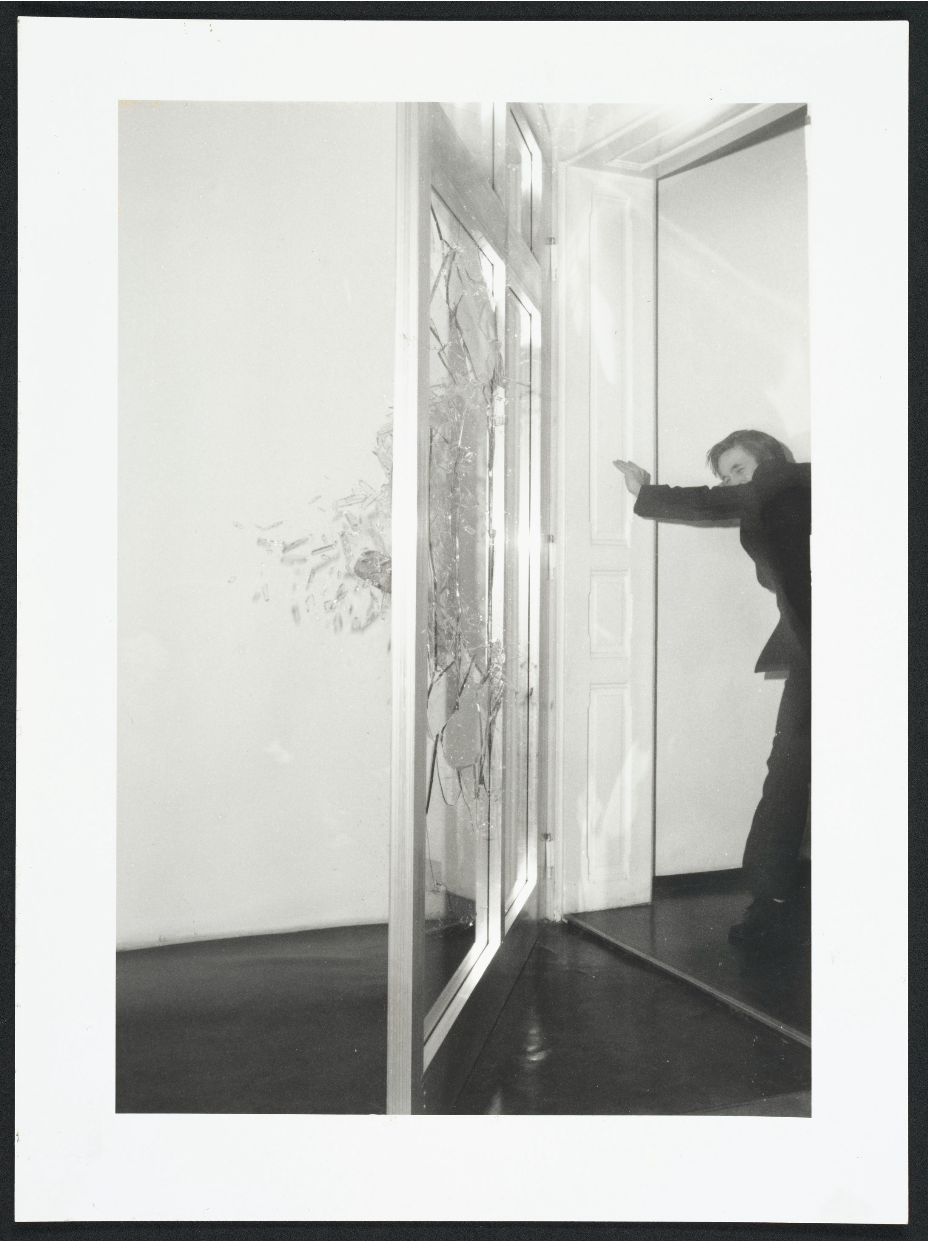
„Untitled (Window) Blow out“
Richard Hoeck, 1991
Fotografie
23,9 x 17,8 cm
first exhibition: Grazer Kunstverein and Galerie & Edition Artelier, December 1991
latest exhibition: „Fernheilung. Die 1980er und frühen 1990er Jahre im Zerrspiegel einer Sammlung“, kuratiert von Robert Müller im Dialog mit Helmut Draxler, 16. Oktober 2025 – 31. Januar 2026, Universitätsgalerie der Angewandten, Wien — MORE INFO
Richard Hoeck’s first major exhibit took place at Galerie & Edition Artelier and the Grazer Kunstverein in December 1991. In retrospect, it clearly registers the breakup of the Soviet Union and the Eastern Bloc. Mainstream commentators took the breakup to be definitive proof of socialism’s irrelevance. Yet, within the uncanny arena of uncontested capitalism, socialist principles became more topical and more problematized than they had been under an objectifiable communist state.
Hoeck’s exhibit consisted of three parts. The first was a freestanding glass window installed near Artelier’s entrance. Before the opening, Hoeck smashed the window with a rock, leaving shards of glass strewn around the doorway. (He also videotaped the action and edited it as a kind of playful choreography.) The second was a set of 56 silkscreens. These, Hoeck based indirectly on Kasimir Malevich’s plaster models for architectural projects — which, over time, have been damaged or destroyed. Based on remaining fragments, the Parisian architectural firm, Petersen, produced drawings of the projects. Hoeck’s version subtly altered the scale set forth in the Petersen reconstructions. The third took place at the Grazer Kunstverein, which then shared a common doorway with Artelier. There, Hoeck installed a stage and a fully equipped bar. He scheduled a jazz band called Night and Day (Rudiger Carl, Alexander von Schlittenbach, Jay James Oliver and Sven-äke Johansson) to play for one night.
Among other things, the broken window refers to rioting or insurrection. The kind of windows which get broken then are typically shop windows — which, by separating public from private space, play a part in consecrating private property. By installing a similar such window within a private art gallery, Hoeck accordingly conflates public and private space and thereby questions the flaneur-like role of the art spectator. (The flaneur, according to Walter Benjamin. treats the street as his living room.) The playful videotape version of the action insinuates a carnivalesque view of revolution, one defined more as festival than armed conflict. Ultimately. however, Hoeck had destroyed his own property. This willful destruction, not „creation,“ commands viewers‘ attention.
As construction plans, the Malevich drawings contrasted sharply with the window piece. Nevertheless, Hoeck refused to accept the Petersen reconstructions as affirmations of a hallowed past, even if it were one that history had never realized. By making almost imperceptible changes in these, he cast doubt on the common-sense notion that history is something that actually happened. The ruler appearing on the left side of each rendering purports to guarantee its accuracy. It also gives
the Malevich project the character of an anthropological artifact. Instead of the viewer’s cultural birthright. it thus seems part of a remote. „other“ culture. By altering their scale. Hoeck transformed the apparent objectification of these drawings into a means of their falsification. This highlights the latent — yet nonetheless real — historical potential of Malevich’s utopian longing.
The concert staged by Hoeck in the Grazer Kunstverein integrated the work of other artists — here, musicians — into an overarching logic of de-contextualization and re-contextualization. During the performance, at least, the Kunstverein became a de facto nightclub; the „seriousness“ typical of so-called fine art gave way to a degree of hedonism. Yet, since jazz is obviously art music, Hoeck avoided playing „the high/low card.“ The music’s formal, improvisational structure calls into question the value of time plus the separation of work and play. As Norman Mailer put it, jazz is like orgasm: good and bad orgasm.
Hoeck’s first exhibition makes the most sense as an ensemble. Each part qualifies the others. Together, they address not only the social configuration of space but also the conventional role of the artist. Via the window, the Malevich drawings and the provisional nightclub, Hoeck undermines the reified character of public and private space, leaving it „up for grabs.“ In tandem, the figure of the artist assumes multiple guises: vandal, visionary, forger, entertainer or entrepreneur. Still, art-making promises to overcome the division between work and leisure. Hoeck reminds his audience that the artist-figure remains a necessary counterpoint to the ideologically conditioned experience of social space — what otherwise passes for reality.
(Text by John Miller)